Pearson Edexcel · GCSE · Business
Course version: 1BS0 · Version from Sept 2017
The types of business ownership for growing businesses: ● public limited…
Full specification wording
Business growth: The types of business ownership for growing businesses: ● public limited company (plc)
A public limited company (plc) is an incorporated business ownership structure suited for large, growing businesses.
Checked against the Pearson Edexcel 1BS0 specification (opens in a new tab) on .
- Point 2 of 3
- 4 key terms
Study notes
From the checked teaching notes for this specification point.
The idea
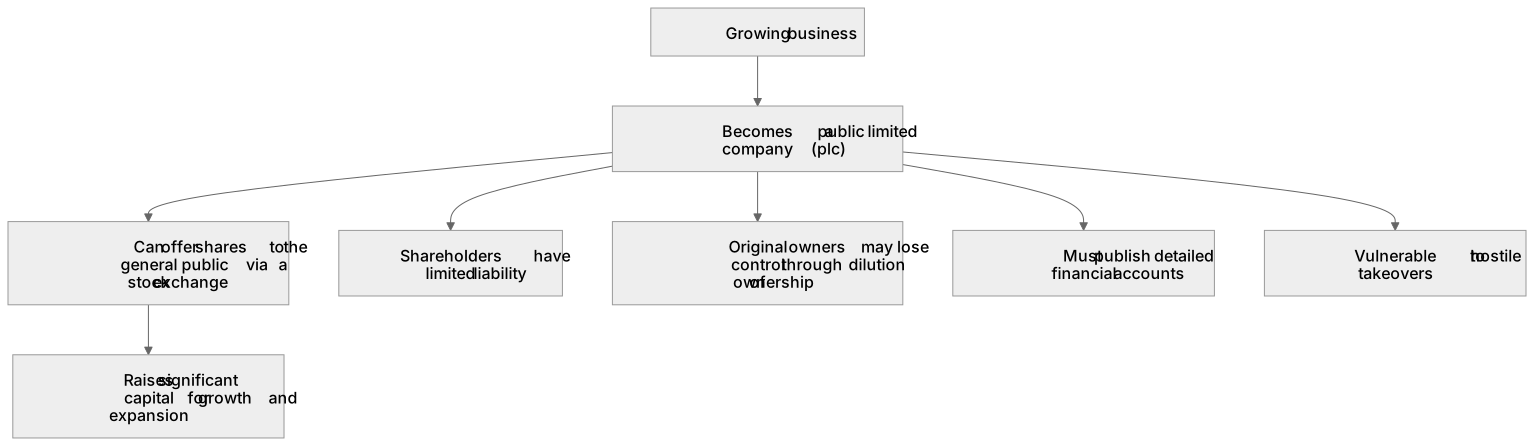
A public limited company (plc) is an incorporated business ownership structure suited for large, growing businesses. Unlike private limited companies, a plc can offer its shares to the general public via a stock exchange, such as the London Stock Exchange. This ability to raise vast amounts of capital makes it ideal for funding major expansion projects, like entering international markets or building new factories. However, becoming a plc means the original owners may lose control of the business due to the dilution of ownership among thousands of shareholders. Furthermore, plcs face strict regulatory requirements, must publish detailed financial accounts, and are vulnerable to hostile takeovers. All shareholders benefit from limited liability, meaning they only risk the amount they invested.
What earns the marks
- A plc can sell shares to the general public on a stock exchange.
- Shareholders in a plc have limited liability, protecting their personal assets.
- Going public allows a business to raise significant capital for growth and expansion.
- A disadvantage of a plc is the risk of a hostile takeover if a rival buys a majority of shares.
- Plcs must publish their financial accounts, reducing privacy compared to a private limited company.
Common mistakes and how to put them right
Stating that a plc is owned by the government.
Put it right: A plc is owned by private shareholders who buy shares on the stock market; government-owned businesses are public sector organisations.
Claiming that owners of a plc have unlimited liability.
Put it right: Shareholders in a plc have limited liability and can only lose their original investment.
Confusing a plc with a private limited company (ltd).
Put it right: An ltd can only sell shares to friends and family with agreement from other shareholders, whereas a plc can sell to the general public.
Exam tips
- When evaluating whether a business should become a plc, weigh the benefit of raising large amounts of capital against the loss of control.
- Use the term 'divorce of ownership and control' to explain how shareholders own the plc but a board of directors runs it.
- Always link the choice of becoming a plc to the specific growth objectives mentioned in the case study.
Try the lesson
The start of the Business growth: The types of business ownership for growing businesses: ● public limited company (plc) lesson, made from checked teaching notes for this specification point.
Have a go first
Which of the following is a key characteristic of a public limited company (plc)?
Listen
A public limited company (plc) is an incorporated business ownership structure suited for large, growing businesses. Unlike private limited companies, a plc can offer its shares to the general public via a stock exchange, such as the London Stock Exchange. This ability to raise vast amounts of capital makes it ideal for funding major expansion projects, like entering international markets or building new factories. However, becoming a plc means the original owners may lose control of the business due to the dilution of ownership among thousands of shareholders. Furthermore, plcs face strict regulatory requirements, must publish detailed financial accounts, and are vulnerable to hostile takeovers. All shareholders benefit from limited liability, meaning they only risk the amount they invested. A strong answer earns marks for these points. A plc can sell shares to the general public on a stock exchange. Shareholders in a plc have limited liability, protecting their personal assets. Going public allows a business to raise significant capital for growth and expansion. A disadvantage of a plc is the risk of a hostile takeover if a rival buys a majority of shares. A common slip: Stating that a plc is owned by the government. Instead, A plc is owned by private shareholders who buy shares on the stock market; government-owned businesses are public sector organisations. Exam tip: When evaluating whether a business should become a plc, weigh the benefit of raising large amounts of capital against the loss of control.
See it
Key words
Say what each word means before you turn the card.
Public limited company (plc)
Try answering aloud or in your head before turning the card.
Limited liability
Try answering aloud or in your head before turning the card.
Business ownership
Try answering aloud or in your head before turning the card.
Business growth
Try answering aloud or in your head before turning the card.
See every definition
- Public limited company (plc)
- An incorporated business ownership structure suited for large, growing businesses that can offer its shares to the general public via a stock exchange.
- Limited liability
- Shareholders only risk the amount they invested, protecting their personal assets.
- Business ownership
- The structure of a business, such as a public limited company, which a growing business might change to.
- Business growth
- Expansion that a plc can fund by raising significant capital, such as entering international markets or building new factories.
Label the diagram
Some boxes have lost their names. Pick the right name for each number.
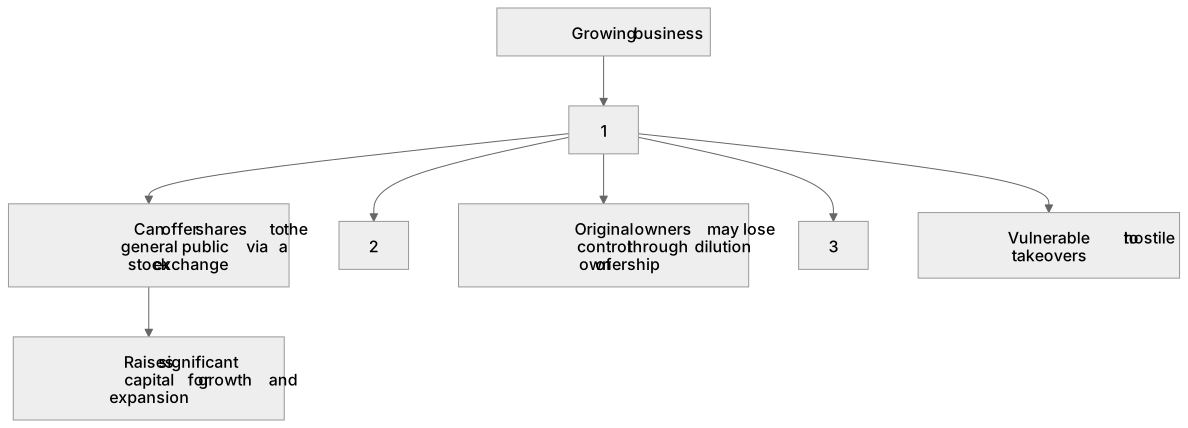
1Box 1
2Box 2
3Box 3
There is more to this lesson
The full lesson goes on to check your understanding and help you earn the marks. Create a free account to carry on, with your progress saved.
A week of Premium from your first lesson · Then the free plan continues · No card, no charge
Test your understanding of Business growth: The types of business ownership for growing businesses: ● public limited company (plc)
Active recall beats re-reading. Take an instant quiz now to test what you’ve learned and lock it into long-term memory.
A week of Premium from your first lesson · Then the free plan continues · No card, no charge